Cookie Consent
By clicking “Accept”, you agree to the storing of cookies on your device to enhance site navigation, analyze site usage, and assist in our marketing efforts. View our Privacy Policy for more information.

The government has now published the response to the Future Homes Standard consultation, giving our industry a clear view of the performance requirements for new-build homes from 2027. For aluminium systems, the update brings welcome clarity. The notional U-Value for windows is set at 1.2 W/m²K, avoiding the previously feared 0.8 W/m²K and supporting a practical balance between efficiency and cost.
From 2027, however, U‑Values must be calculated using the actual size and configuration of each window - not the traditional standard test size. This shift moves the industry toward genuine performance and tighter alignment between designed and delivered energy outcomes.
The rules also expand calculations to include cills, couplers, and add-ons, increasing technical demands for fabricators, installers, and specifiers. This addition added to the changes in calculating U-Values based on actual sizes will present a challenge to the whole industry, but one we’re ready for at AluK. Our estimating software already calculates the whole window U-Values , and all the frame if data we input is validated by third‑party Notified Bodies.
As you’d expect, we are planning our schedule to get all new product simulations done by 2027, so we and our customers will be in a strong position when the FHS comes into force.
We hope you find this guide useful and our team is on‑hand to support you through the process.
For further information and support contact us at: info.uk@aluk.com
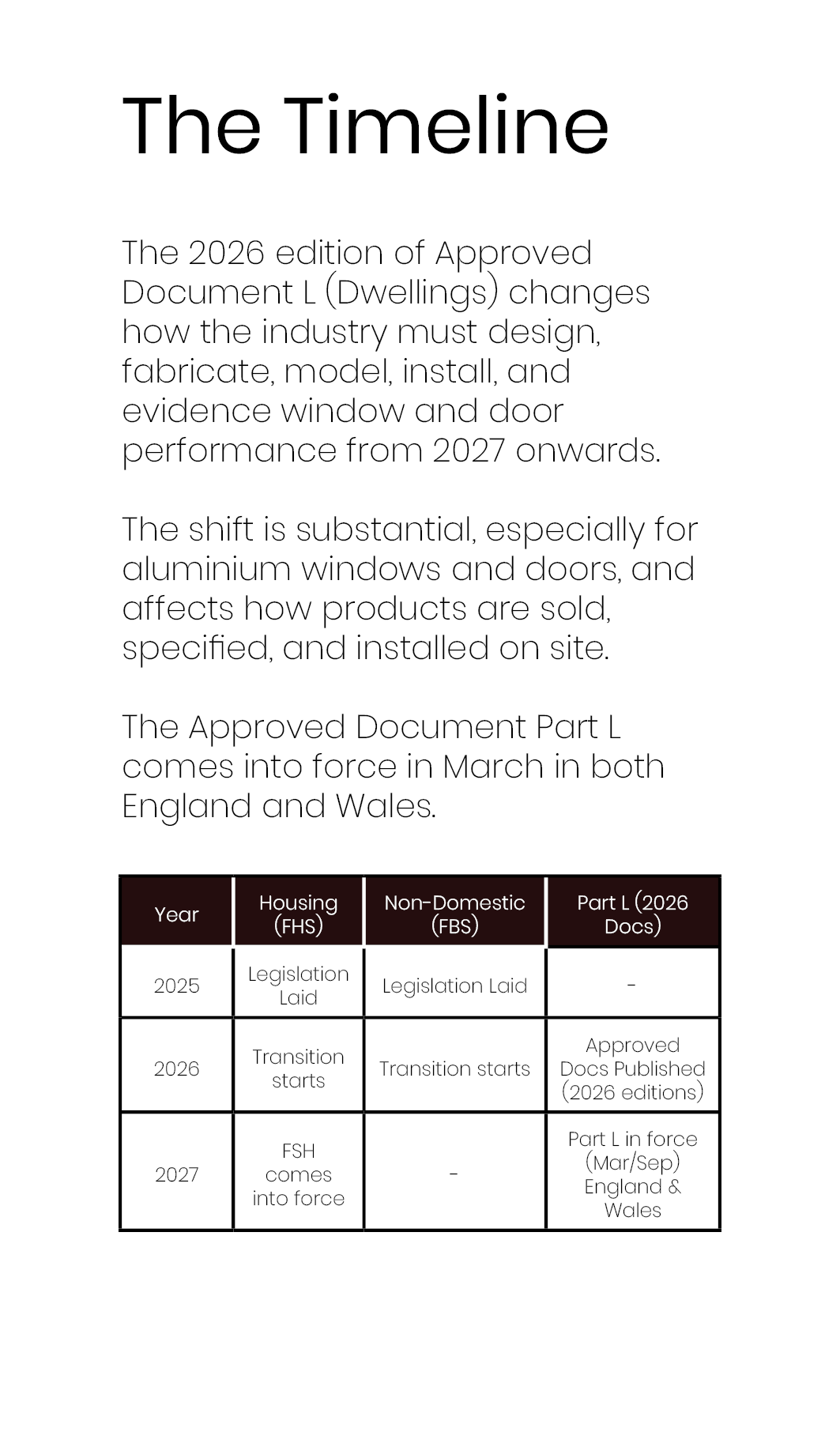
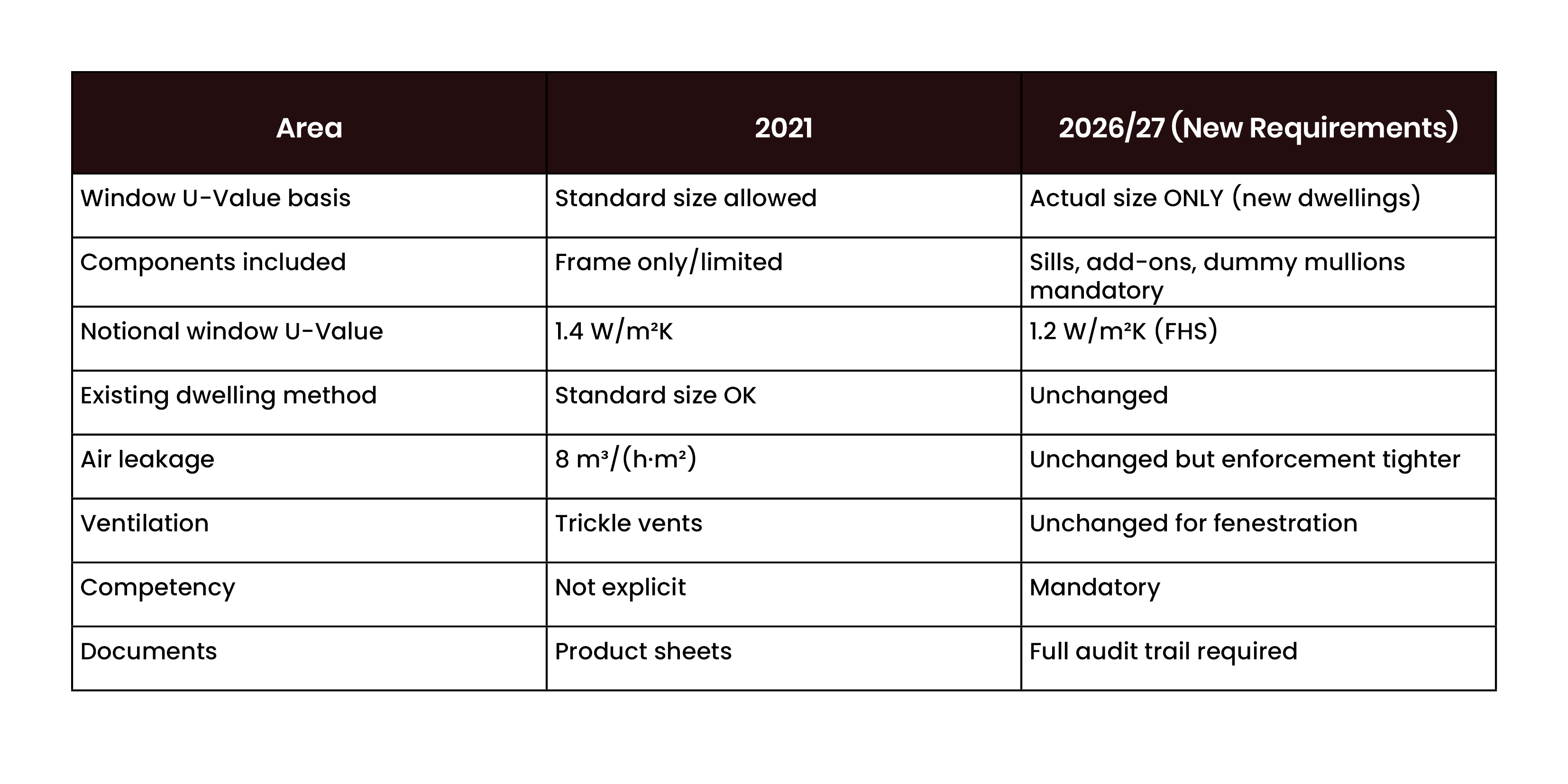
In England, from 2027, U-Values for windows and doors must be calculated using the actual size and configuration of each unit, rather than a standard test size. Until now, calculations could be based on the standard calculation model (ie 1230 x 1480 standard size) but from 2027 onwards, they will have to be based on the actual size and configuration of each individual window, to arrive at an area weighted average. The rules on calculation are slightly different for Wales, and the limiting U-Value for windows and glazed doors is lower, at 1.4 W/m2K.
.png)
Part L now places stronger emphasis on how windows and doors are installed - not just how they’re fabricated.
Window and door frames are taped or sealed to surrounding structure to prevent air leakage.
Penetrations around fixings, cables, or packers are sealed using tapes, membranes, grommets, or sealants.
Installers must ensure: .
Frames connect directly to the primary air barrier, with seals continuous around the full perimeter.
Poor installation can cause a dwelling to fail the pressure test, requiring remedial works.
• Configuration specific U‑Value calculations (using actual sizes).
• All product specifications used in the thermal model.
• Photographic evidence showing the insulation and airtightness measures around the openings before they are covered.
• Installation photos referenced in the BREL report.
Installers must also provide operation and maintenance information to the homeowner within 5 days of completion.
.png)
• Project specific U‑Values, not generic system values.
• Inclusion of all add ons, couplers, and bars in performance calculations.
• Early coordination with installers to ensure airtightness and thermal requirements can be met on site.
• Alignment with Part O (overheating) and Part F (ventilation) where glazing ratios and openings influence building performance.
Installers and fabricators must demonstrate:
• Appropriate skills, knowledge, and experience
• Ability to provide compliant workmanship and documentation
• Competent Person Scheme registration where self certifying
• Providing validated U-Values, thermal bridging data, and full configuration U-Value support.
• Ensuring all profiles and accessories are thermally modelled to 2027 requirements.
• Offering fabrication guidance for fully-compliant solutions.
• Continuing to be transparent in how our products perform.
• Offering project specific thermal modelling.
• Supporting compliant specification for new build, retrofit, and extensions.
• Providing validated U-Values, thermal bridging data, and full configuration U-Value support.
• Ensuring all profiles and accessories are thermally modelled to 2027 requirements.
• Offering fabrication guidance for fully-compliant solutions.
• Continuing to be transparent in how our products perform.
• Offering project specific thermal modelling.
• Supporting compliant specification for new build, retrofit, and extensions.

WER/DSERs is a rating system that is based upon a scale of E to A++, A++ being the most energy efficient.
This scheme is similar to the household appliance scheme that you see on white goods like fridges.
WER/DSERs can be used as a compliance method, but only for Existing Dwellings and ‘domestic type windows’ on Other Buildings.
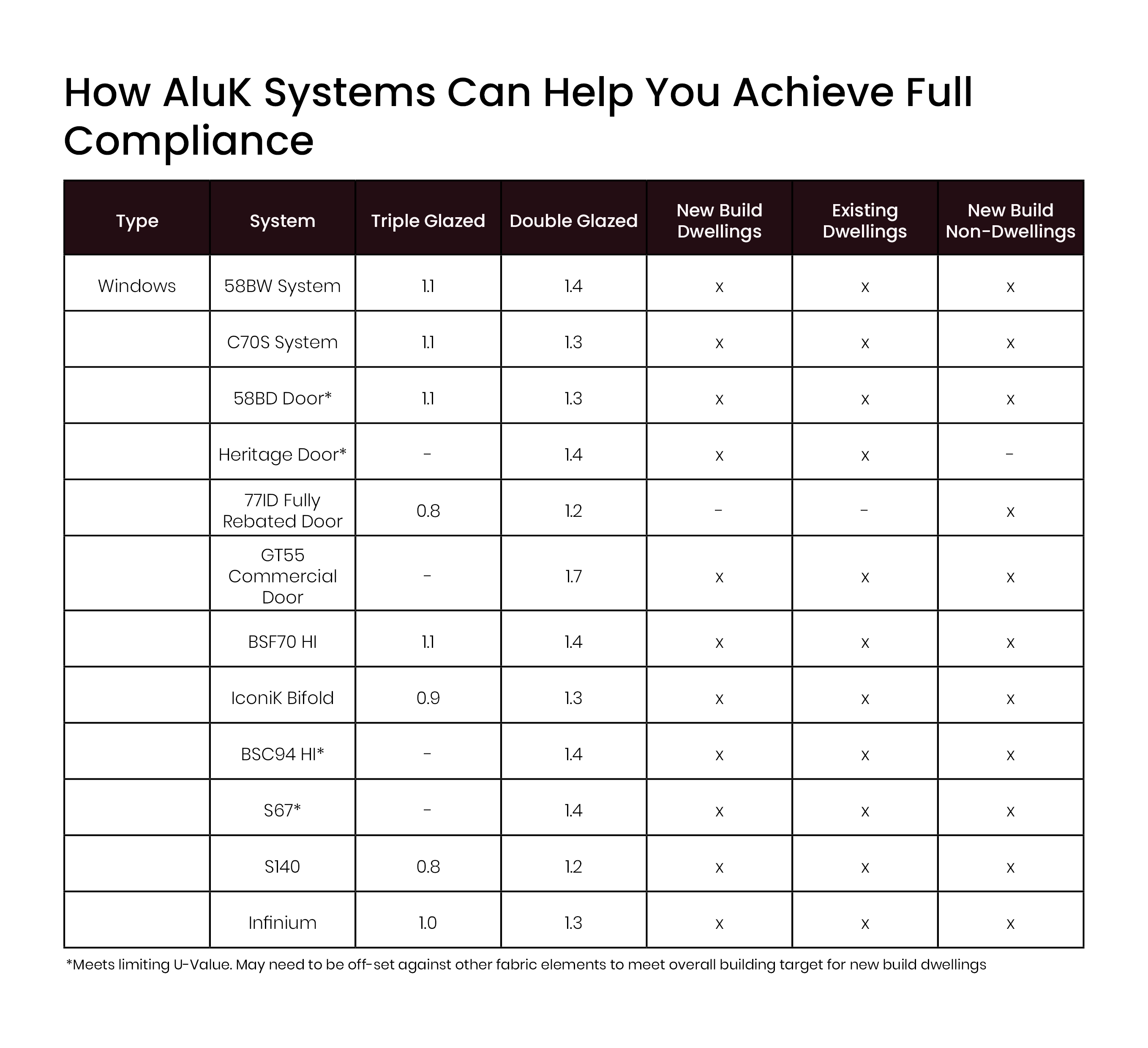
Notional and limiting values are aimed at offering flexibility in the design and development of a building. Allowing different elements to vary in performance as long as the overall targets are met and the limiting values are not exceeded.
When establishing the building fabric performance, designers are advised to start the process with each building element value set to the notional value and not the limiting value.
All AluK products developed for use in the New Build Dwellings market have been designed around the notional value to ensure the building fabric complies with performance requirements within the updated approved document.

If you’d like more information on the Future Homes Standard, changes to Part L and AluK’s Part L-ready products, please get in touch with your local Area Sales Manager.
Call us on +44(0)1291 639 739
For project advice, contact the AluK Team at: Info.uk@aluk.com
Follow the latest on our social channels:


